














Old Rare Map of Canada by Chatelain, 1719: Great Lakes, Hudson Bay, St. Lawrence, Detroit, Montreal

Restored in our London workshop from the original 1719 map and printed to museum-grade archival standards. Full description
The Collector’s Offer
Choose two eligible works and receive 20% off both. Choose three and the lowest-priced one is complimentary, a maximum saving of 33%.
Mix and match eligible standard maps and fine-art prints. No code is required; the offer is applied automatically at checkout.
Standard made-to-order configurations are included. Bespoke sizes, personalised designs and commissioned work are excluded.
Need delivery to different addresses? Contact us before ordering.The Collector’s Offer
Choose two eligible works and receive 20% off both. Choose three and the lowest-priced one is complimentary, a maximum saving of 33%.
Mix and match eligible standard maps and fine-art prints. No code is required; the offer is applied automatically at checkout.
Standard made-to-order configurations are included. Bespoke sizes, personalised designs and commissioned work are excluded.
Need delivery to different addresses? Contact us before ordering. Restored in London • Printed and framed in Australia
Restored from the original 1719 map and printed to museum-grade archival standards. Full description
Choose your size
Choose your finish


(More info)
Gift message & custom finish

If you want to add a gift message, or a finish (jigsaw, aluminium board, etc.) that is not available here, please request it in the "order note" when you check out.
Every order is custom made, so if you need the size adjusted slightly, or printed on an unusual material, just let us know. We've done thousands of custom orders over the years, so there's (almost) nothing we can't manage.
You can also contact us before you order, if you prefer!
Own a piece of history
8,000+ five-star reviews


Henri Chatelain’s 1719 Carte du Canada ou de la Nouvelle France, & des Decouvertes qui ont été faites presents an authoritative early-eighteenth-century...
Continue readingHenri Chatelain’s 1719 Carte du Canada ou de la Nouvelle France, & des Decouvertes qui ont été faites presents an authoritative early-eighteenth-century vision of northern North America, sweeping from the St. Lawrence to the Mississippi and up to the icy reaches of Hudson Bay. The composition is anchored by an ornate explanatory cartouche and a Remarque Historique that frames the rise of New France in learned prose. Within this grand tableau, Chatelain achieves a notable milestone: one of the first accurate placements of Detroit, charted only years after its founding, alongside the established colonial pillars of Montreal and Quebec. Rivers lace the land like arteries—the Ottawa, the Illinois, and the Mississippi among them—while the Great Lakes form a shimmering inland sea that structures the geography, the commerce, and the ambitions of an expanding Atlantic world.
Chatelain, the polymath compiler of the Atlas Historique, excelled at marrying rigorous geography with erudite narrative. Drawing on Guillaume De L’Isle’s groundbreaking measurements—especially the corrected outlines of the Great Lakes—he transformed technical cartography into an encyclopedic stage set for exploration and empire. His map is studded with annotations that name explorers and their routes, from the St. Lawrence corridor to the continental interior, and even nods to northern claims under the rubric of “Nouveau Danemarc.” The Remarque Historique situates these discoveries within a longer chronology, allowing the viewer to track how scattered voyages, trading posts, and mission stations congealed into a coherent French geographic imagination of Canada and its borderlands.
Water defines the structure and strategy of this map. The chain of Superior, Michigan, Huron, Erie, and Ontario is rendered with a clarity that elevates their role as the hinge between the Atlantic and the continental heartland. Detroit sits precisely on the strait that links Lake St. Clair and Lake Erie, a new linchpin controlling passage between upper and lower lakes. To the south and west, the Mississippi courses through French ambition, its corridor punctuated by forts such as St. Louis or Crevecoeur near today’s Peoria—evidence of La Salle’s bold design to connect the St. Lawrence world to the Gulf of Mexico. Chatelain’s labels and notes trace these waterborne corridors, revealing the practical pathways by which furs, news, and ideas moved.
The northern and western reaches mix empirical knowledge with tantalizing speculation. Along Hudson Bay and the subarctic coastlines, the map identifies the “Eskimaux,” while inland territories record the “Christinaux or Kilistinons,” reflecting Europe’s growing awareness of Indigenous homelands engaged in the fur trade. In the interior, the celebrated “Riviere Longue” appears—an echo of contemporary debates sparked by Baron de Lahontan—extending a hypothetical waterway toward the unknown West. Such features do not weaken the map; they articulate the boundary where confirmed observation yielded to conjecture, and where competing European claims, signaled by notes like “Nouveau Danemarc,” brushed the fringes of ice-choked seas and unmapped plains.
Politically, the sheet captures a moment when New France’s reach was broad but borders remained fluid, braided through alliances, rivers, and posts rather than fixed lines. Montreal and Quebec City emerge as keystones of administration and commerce, their influence projected through missions and forts that stud the lakeshores and riverbanks. Chatelain’s synthesis—De L’Isle’s precision enriched with historical commentary—turns the geography of Canada and the Great Lakes into a narrative of contest and connection. By uniting hard-won measurements with chronicles of explorers and nations, and by fixing Detroit with striking accuracy so early in its life, the map offers a rare, lucid window into how Europe pictured North America at a pivotal juncture.
Cities and towns on this map
- Montreal
- Quebec City
- Detroit
- Peoria (historically noted as the site of the fort 'St. Louis' or 'Crevecouer')
Notable Features & Landmarks
- Major Bodies of Water: Great Lakes, Hudson Bay, several rivers including the Mississippi River.
- Cartouche: An ornate decorative element that includes an explanation of the map’s content.
- Notes on Exploration: Annotations detailing explorers and their associated discoveries, such as 'Nouveau Danemarc'.
- Indigenous Tribes: Labels identifying regions inhabited by native tribes, such as the "Christinaux or Kilistinons" and "Eskimaux".
- Mythical River: The representation of the "Riviere Longue".
- Military Forts: Location of French forts like 'St. Louis' or 'Crevecouer'.
- "Remarque Historique": A historical note explaining the context of New France throughout time.
Historical and design context
- Date Created: 1719
- Mapmaker: Henri Chatelain — produced as part of his Atlas Historique and known for enhancing earlier cartographic works, notably those of De L'Isle.
- Themes: Political and physical representation of Canada, the Great Lakes, and surrounding areas; depicts significant explorers and discoveries, showcasing European exploration in North America.
- Countries/Regions: Canada, regions around the Great Lakes, parts of present-day United States, and references to various indigenous tribes.
- Design & Style: Features a rich and colorful depiction, with a highly ornate cartouche reflecting the artistic style of the period.
- Historical Significance: One of the first maps to accurately locate Detroit shortly after its founding; represents a pivotal moment in North American cartographic history and offers insight into European understandings of the continent in the early 18th century.
Please double check the images to make sure that a specific town or place is shown on this map. You can also get in touch and ask us to check the map for you.
This map looks great at every size, but I always recommend going for a larger size if you have space. That way you can easily make out all of the details.
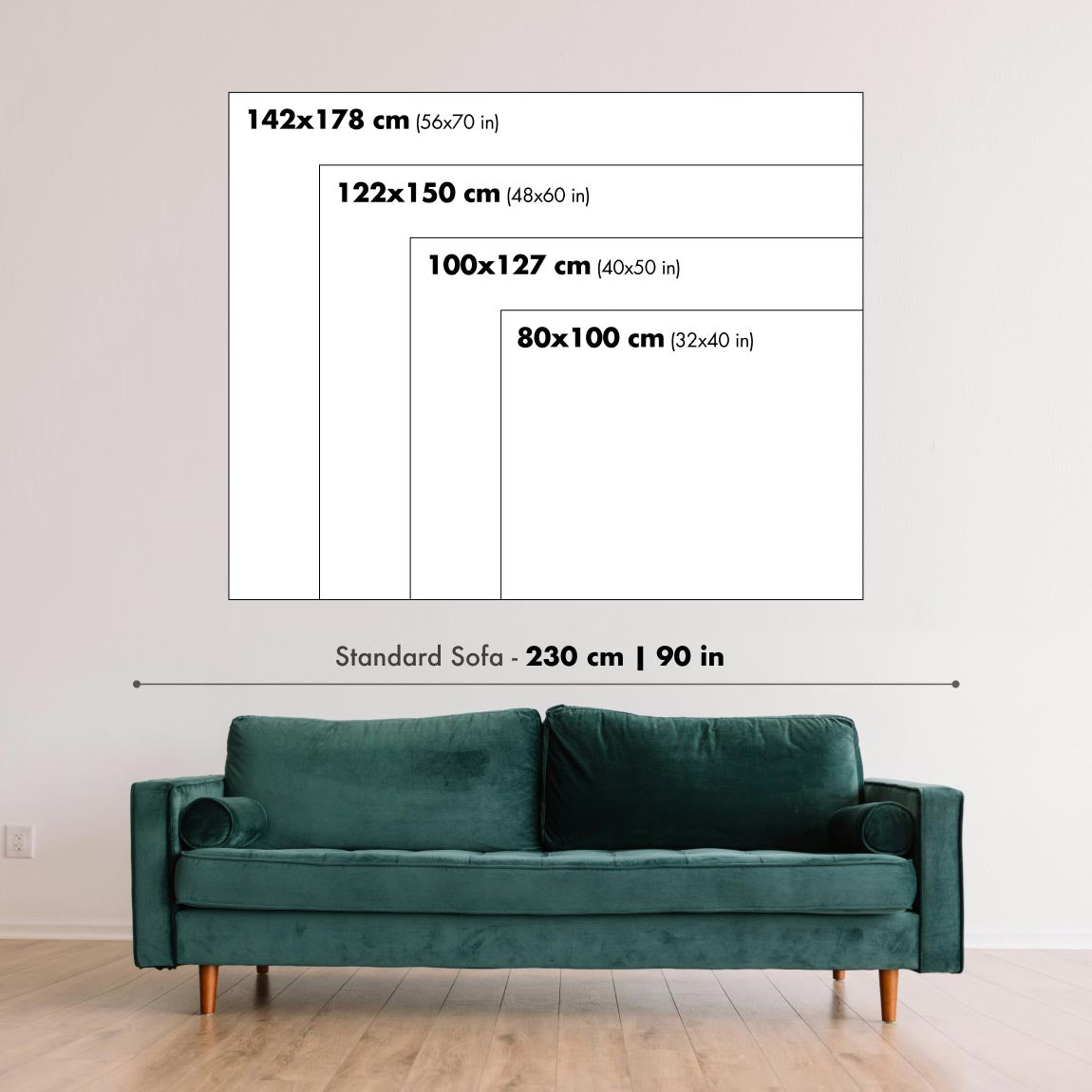
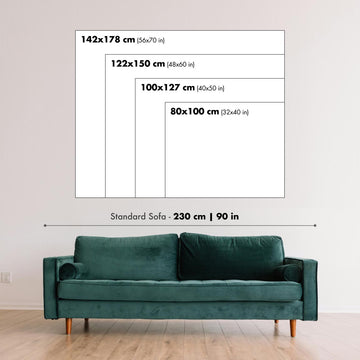
This map looks amazing at sizes all the way up to 90in (230cm). If you are looking for a larger map, please get in touch.
The model in the listing images is holding the 16x20in (40x50cm) version of this map.
The fifth listing image shows an example of my map personalisation service.
If you’re looking for something slightly different, check out my collection of the best old maps to see if something else catches your eye.
Please contact me to check if a certain location, landmark or feature is shown on this map.
This would make a wonderful birthday, Christmas, Father's Day, work leaving, anniversary or housewarming gift for someone from the areas covered by this map.
This map is available as a giclée print on acid free archival matte paper, or you can buy it framed. The frame is a nice, simple black frame that suits most aesthetics. Please get in touch if you'd like a different frame colour or material. My frames are glazed with super-clear museum-grade acrylic (perspex/acrylite), which is significantly less reflective than glass, safer, and will always arrive in perfect condition.
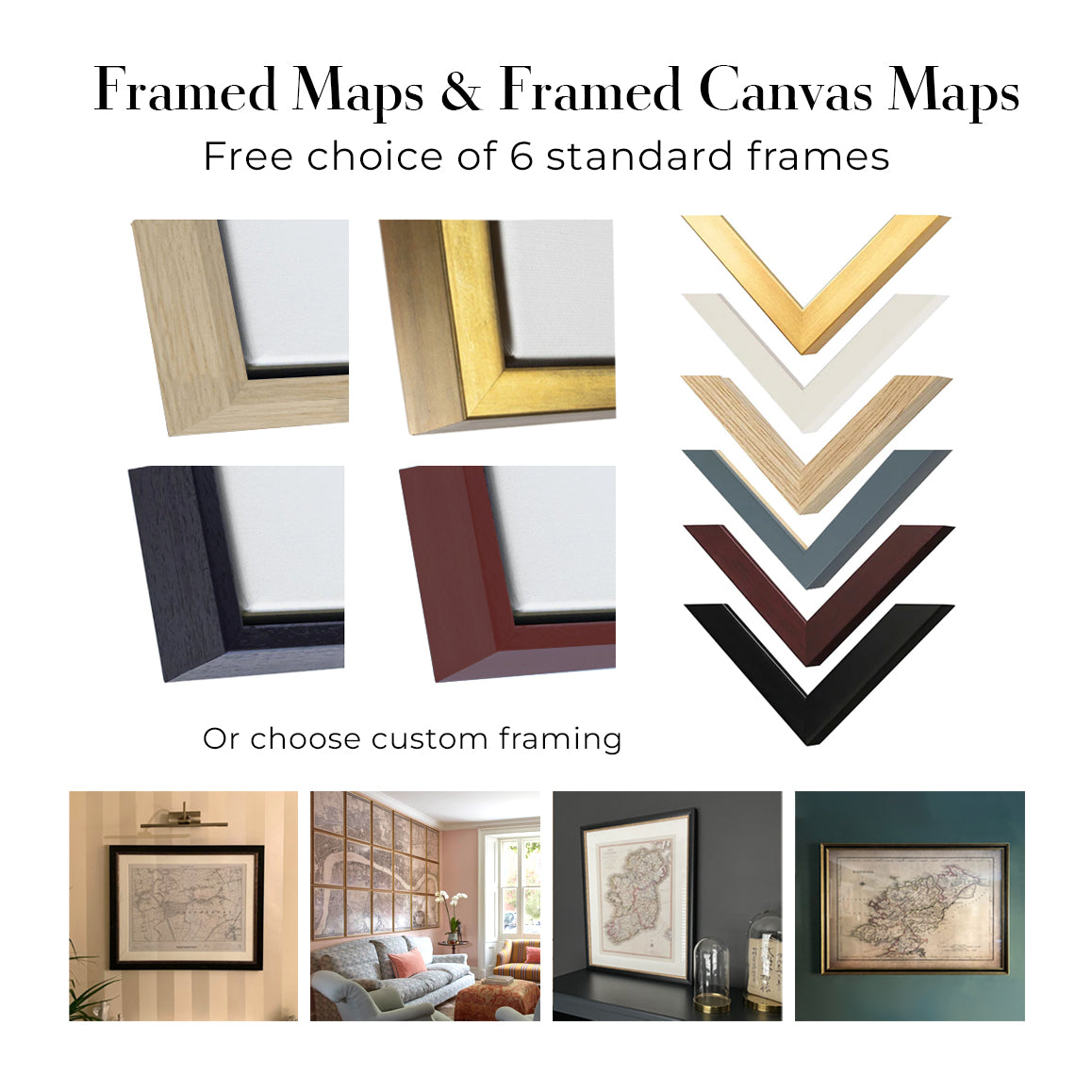
This map is also available as a float framed canvas, sometimes known as a shadow gap framed canvas or canvas floater. The map is printed on artist's cotton canvas and then stretched over a handmade box frame. We then "float" the canvas inside a wooden frame, which is available in a range of colours (black, dark brown, oak, antique gold and white). This is a wonderful way to present a map without glazing in front. See some examples of float framed canvas maps and explore the differences between my different finishes.
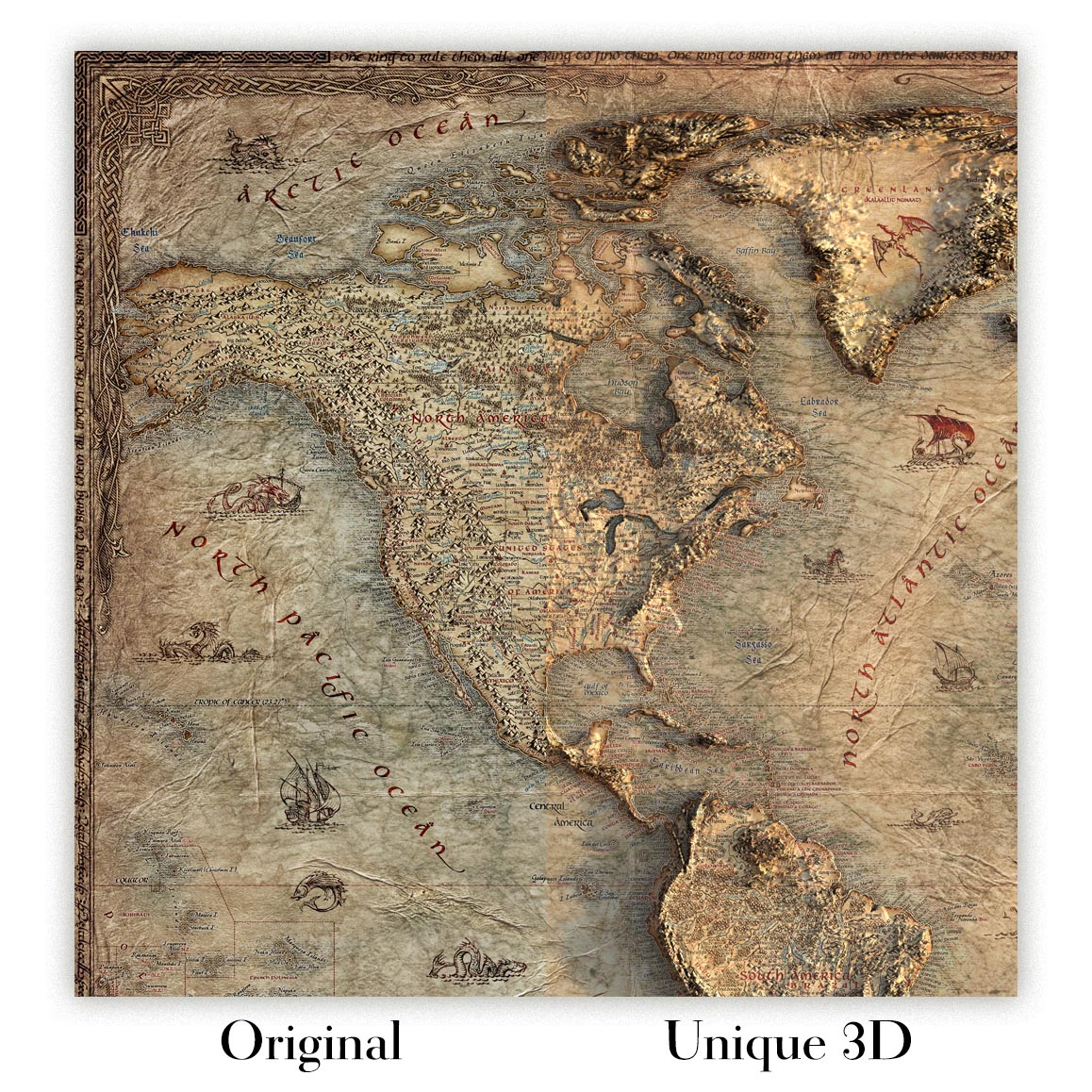
For something truly unique, this map is also available in "Unique 3D", our trademarked process that dramatically transforms the map so that it has a wonderful sense of depth. We combine the original map with detailed topography and elevation data, so that mountains and the terrain really "pop". For more info and examples of 3D maps, check my Unique 3D page.
Henri Chatelain’s 1719 Carte du Canada ou de la Nouvelle France, & des Decouvertes qui ont été faites presents an authoritative early-eighteenth-century vision of northern North America, sweeping from the St. Lawrence to the Mississippi and up to the icy reaches of Hudson Bay. The composition is anchored by an ornate explanatory cartouche and a Remarque Historique that frames the rise of New France in learned prose. Within this grand tableau, Chatelain achieves a notable milestone: one of the first accurate placements of Detroit, charted only years after its founding, alongside the established colonial pillars of Montreal and Quebec. Rivers lace the land like arteries—the Ottawa, the Illinois, and the Mississippi among them—while the Great Lakes form a shimmering inland sea that structures the geography, the commerce, and the ambitions of an expanding Atlantic world.
Chatelain, the polymath compiler of the Atlas Historique, excelled at marrying rigorous geography with erudite narrative. Drawing on Guillaume De L’Isle’s groundbreaking measurements—especially the corrected outlines of the Great Lakes—he transformed technical cartography into an encyclopedic stage set for exploration and empire. His map is studded with annotations that name explorers and their routes, from the St. Lawrence corridor to the continental interior, and even nods to northern claims under the rubric of “Nouveau Danemarc.” The Remarque Historique situates these discoveries within a longer chronology, allowing the viewer to track how scattered voyages, trading posts, and mission stations congealed into a coherent French geographic imagination of Canada and its borderlands.
Water defines the structure and strategy of this map. The chain of Superior, Michigan, Huron, Erie, and Ontario is rendered with a clarity that elevates their role as the hinge between the Atlantic and the continental heartland. Detroit sits precisely on the strait that links Lake St. Clair and Lake Erie, a new linchpin controlling passage between upper and lower lakes. To the south and west, the Mississippi courses through French ambition, its corridor punctuated by forts such as St. Louis or Crevecoeur near today’s Peoria—evidence of La Salle’s bold design to connect the St. Lawrence world to the Gulf of Mexico. Chatelain’s labels and notes trace these waterborne corridors, revealing the practical pathways by which furs, news, and ideas moved.
The northern and western reaches mix empirical knowledge with tantalizing speculation. Along Hudson Bay and the subarctic coastlines, the map identifies the “Eskimaux,” while inland territories record the “Christinaux or Kilistinons,” reflecting Europe’s growing awareness of Indigenous homelands engaged in the fur trade. In the interior, the celebrated “Riviere Longue” appears—an echo of contemporary debates sparked by Baron de Lahontan—extending a hypothetical waterway toward the unknown West. Such features do not weaken the map; they articulate the boundary where confirmed observation yielded to conjecture, and where competing European claims, signaled by notes like “Nouveau Danemarc,” brushed the fringes of ice-choked seas and unmapped plains.
Politically, the sheet captures a moment when New France’s reach was broad but borders remained fluid, braided through alliances, rivers, and posts rather than fixed lines. Montreal and Quebec City emerge as keystones of administration and commerce, their influence projected through missions and forts that stud the lakeshores and riverbanks. Chatelain’s synthesis—De L’Isle’s precision enriched with historical commentary—turns the geography of Canada and the Great Lakes into a narrative of contest and connection. By uniting hard-won measurements with chronicles of explorers and nations, and by fixing Detroit with striking accuracy so early in its life, the map offers a rare, lucid window into how Europe pictured North America at a pivotal juncture.
Cities and towns on this map
- Montreal
- Quebec City
- Detroit
- Peoria (historically noted as the site of the fort 'St. Louis' or 'Crevecouer')
Notable Features & Landmarks
- Major Bodies of Water: Great Lakes, Hudson Bay, several rivers including the Mississippi River.
- Cartouche: An ornate decorative element that includes an explanation of the map’s content.
- Notes on Exploration: Annotations detailing explorers and their associated discoveries, such as 'Nouveau Danemarc'.
- Indigenous Tribes: Labels identifying regions inhabited by native tribes, such as the "Christinaux or Kilistinons" and "Eskimaux".
- Mythical River: The representation of the "Riviere Longue".
- Military Forts: Location of French forts like 'St. Louis' or 'Crevecouer'.
- "Remarque Historique": A historical note explaining the context of New France throughout time.
Historical and design context
- Date Created: 1719
- Mapmaker: Henri Chatelain — produced as part of his Atlas Historique and known for enhancing earlier cartographic works, notably those of De L'Isle.
- Themes: Political and physical representation of Canada, the Great Lakes, and surrounding areas; depicts significant explorers and discoveries, showcasing European exploration in North America.
- Countries/Regions: Canada, regions around the Great Lakes, parts of present-day United States, and references to various indigenous tribes.
- Design & Style: Features a rich and colorful depiction, with a highly ornate cartouche reflecting the artistic style of the period.
- Historical Significance: One of the first maps to accurately locate Detroit shortly after its founding; represents a pivotal moment in North American cartographic history and offers insight into European understandings of the continent in the early 18th century.
Please double check the images to make sure that a specific town or place is shown on this map. You can also get in touch and ask us to check the map for you.
This map looks great at every size, but I always recommend going for a larger size if you have space. That way you can easily make out all of the details.
This map looks amazing at sizes all the way up to 90in (230cm). If you are looking for a larger map, please get in touch.
The model in the listing images is holding the 16x20in (40x50cm) version of this map.
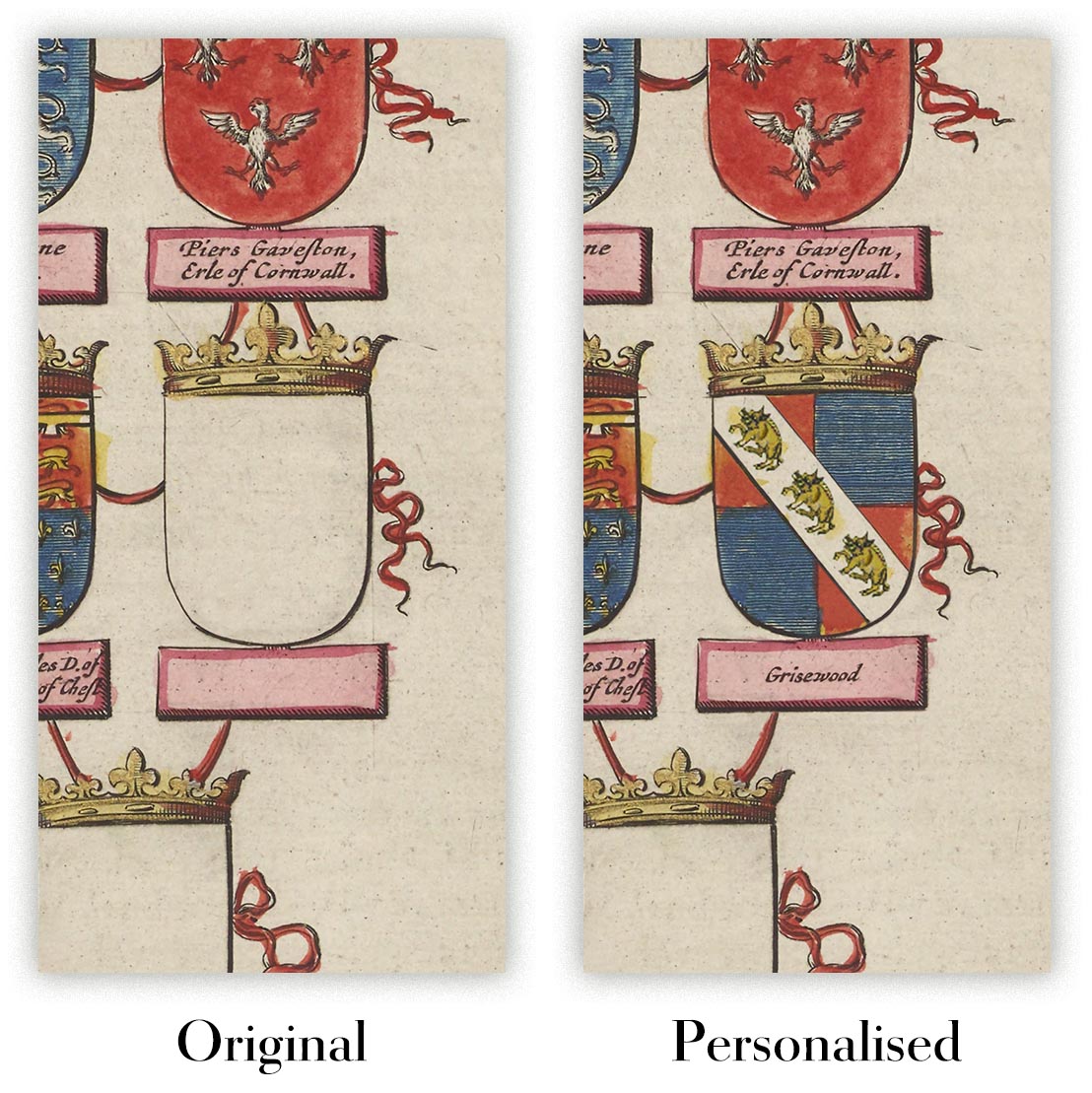
The fifth listing image shows an example of my map personalisation service.
If you’re looking for something slightly different, check out my collection of the best old maps to see if something else catches your eye.
Please contact me to check if a certain location, landmark or feature is shown on this map.
This would make a wonderful birthday, Christmas, Father's Day, work leaving, anniversary or housewarming gift for someone from the areas covered by this map.
This map is available as a giclée print on acid free archival matte paper, or you can buy it framed. The frame is a nice, simple black frame that suits most aesthetics. Please get in touch if you'd like a different frame colour or material. My frames are glazed with super-clear museum-grade acrylic (perspex/acrylite), which is significantly less reflective than glass, safer, and will always arrive in perfect condition.
This map is also available as a float framed canvas, sometimes known as a shadow gap framed canvas or canvas floater. The map is printed on artist's cotton canvas and then stretched over a handmade box frame. We then "float" the canvas inside a wooden frame, which is available in a range of colours (black, dark brown, oak, antique gold and white). This is a wonderful way to present a map without glazing in front. See some examples of float framed canvas maps and explore the differences between my different finishes.
For something truly unique, this map is also available in "Unique 3D", our trademarked process that dramatically transforms the map so that it has a wonderful sense of depth. We combine the original map with detailed topography and elevation data, so that mountains and the terrain really "pop". For more info and examples of 3D maps, check my Unique 3D page.
Many of our maps and art prints are chosen as thoughtful gifts for homes, offices, studies and meaningful places.
Choose a framed option for the easiest ready-to-hang gift, or choose an unframed print if the recipient may prefer to select their own frame.
We make orders locally in 24 countries around the world, so gifts can often be produced close to the recipient. This helps them arrive faster, travel more safely, and avoid customs or import duty surprises.
- We can deliver directly to the recipient
- Framed pieces arrive ready to hang
- Unframed prints are carefully packed in a strong protective tube
- Almost every order is made locally, for faster, safer gifting
- 90-day returns give the recipient time to decide
If you are not sure what to choose, please contact us. We can help you pick the right map, size, finish or delivery option.
Most orders are made locally and delivered in around 2–3 working days, depending on the product, size and destination.
We print and frame maps and artwork in 24 countries around the world, so your order is usually made close to you or your recipient. That means faster delivery, less time in transit, and no customs or import duty surprises.
Personalised and customised pieces usually take an extra 1–2 working days, because we prepare your design and send it to you for approval before printing.
Very large framed orders can take a little longer, as they need extra care in production and delivery.
Every order is carefully packaged: unframed prints are sent in a strong protective tube, while framed pieces are securely packed with protective materials around the frame.
If you need your order by a particular date, please contact us before ordering. We’ll check the best production route and delivery option for your location.
Express delivery is available at checkout for most countries. Next-day delivery is available in the UK, US, Singapore and the UAE.
Your order is covered by our 90-day returns policy and 10-year guarantee.
Our standard frame is a gallery-style black ash hardwood frame, with a simple, modern look. It is approximately 20mm (0.8in) wide. You can also view some lovely customer photos of framed maps and art.
We use super-clear acrylic glazing, also known as Perspex or Acrylite, instead of traditional glass. It is lighter, safer, and has lower reflectivity, giving the artwork a clearer, cleaner appearance.
Six standard frame colours are available at no extra cost: black, dark brown, dark grey, oak, white, and antique gold. Custom framing and mounting/matting is also available for customers looking for something more specific.
Most maps, art prints, and illustrations are also available as a framed canvas. We use matte cotton canvas, stretch it over a sustainably sourced wooden box frame, and then float the piece within a wooden outer frame. The finished result is beautifully presented, with no glazing between you and the artwork.
All frames are supplied ready to hang, with either string or brackets fitted to the back. Very large frames will include heavy-duty hanging plates and/or a mounting baton. If you have any questions, please get in touch.
We can also supply old maps and artwork on canvas, foam board, cotton rag, and other materials.
If you would prefer to frame your map or artwork yourself, please read our size guide before ordering.
We work with interior designers, hospitality businesses, property professionals, offices and corporate buyers on individual pieces and larger coordinated projects.
This map can be adapted for a particular wall, room or project, and our workshop can help coordinate the dimensions, material and framing before production.
- Exact, oversized and made-to-measure dimensions
- Custom framing, mounting and alternative materials
- Coordinated pieces for several rooms or locations
- Map personalisation, to mark important locations or add extra details
- Map and framing guidance from our workshop
- Local production for projects around the world
Every Unique Maps piece begins with an authentic cartographic source or an original design from our London studio.
For our historic maps, we source rare originals from libraries, archives, auction houses and private collections around the world. We carefully restore each map for print—repairing age-related damage, balancing colour and improving clarity while preserving its original detail, texture and character.
Once restored, the map is prepared for your chosen size and finish. Your piece is then printed and, where selected, framed close to its delivery destination.
Our map prints use acid-free 200gsm archival matte paper and fade-resistant pigment inks, creating a rich, non-glossy finish designed to last. Framed maps use crystal-clear optical acrylic and arrive ready to hang.
Canvas, cotton-rag and other specialist presentations are also available. Learn more about our materials and finishes.
Personalising your map
You can add a short title or dedication, mark one meaningful place, or request one considered visual detail. For personalised designs, we send a proof before printing and you can request changes before approval.
For more complex bespoke commissions, contact our design team.
Original or Aged
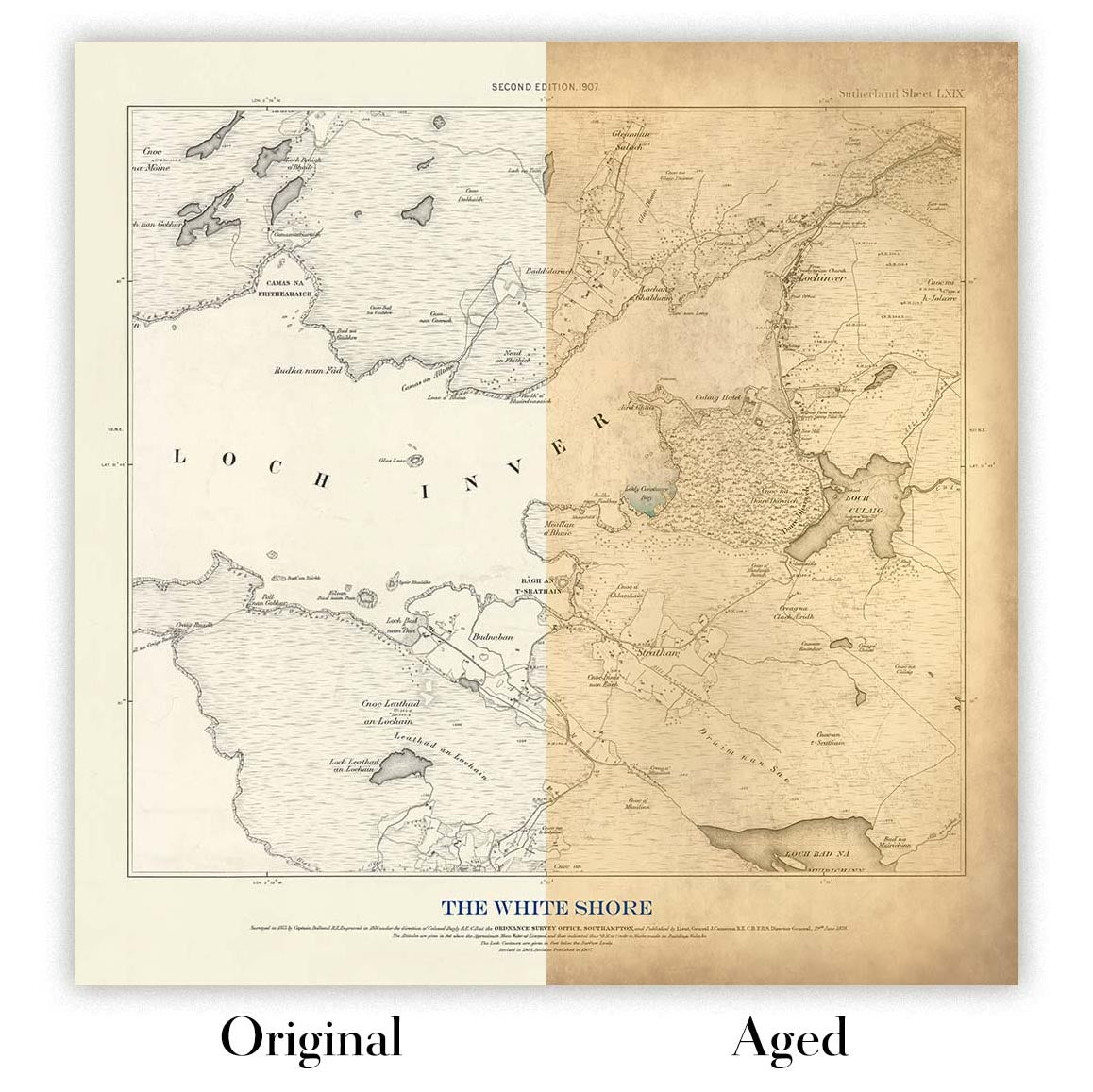
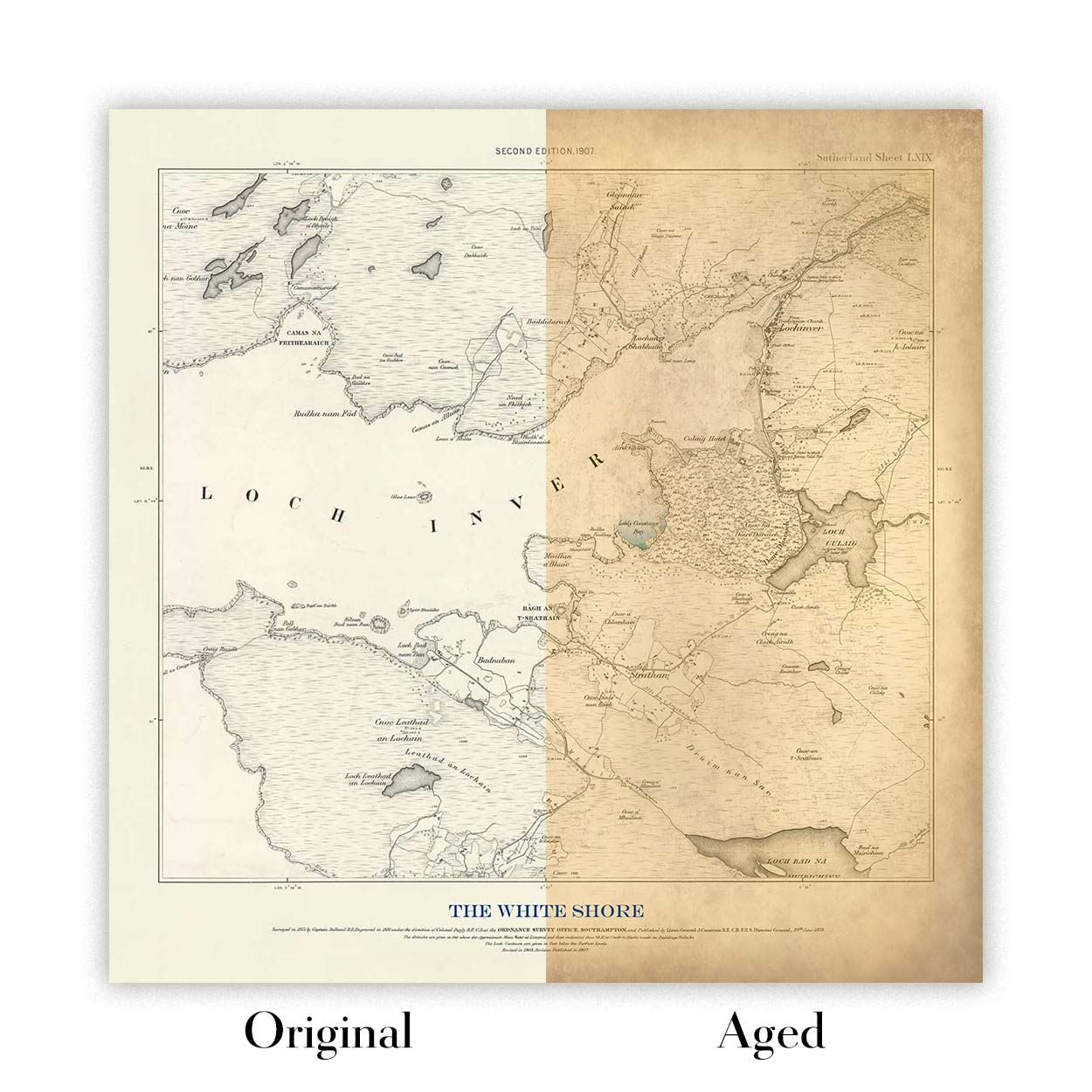
Choose Original for true-to-source colour, or Aged for a warmer, richer antique character created with our specialist ageing process. See examples of our Aged maps.
We’ve been restoring and producing maps and art prints since 1984, and we stand behind every piece.
Every order is covered by our 10-year guarantee and damage-free delivery guarantee. If your piece arrives damaged, we’ll replace or remake it free of charge. If anything else isn’t right, contact our workshop team and we’ll put it right promptly.
See our returns and refund policy for full details.
Or try searching for something!


